CurveSimilarities documentation#
A collection of curve similarity measures.
There are tons of similar packages published on PyPI, but this one aims to be the most NumPy-friendly and the easiest to use.
API reference#
To reproduce the examples, run the following code first:
import numpy as np
from curvesimilarities import *
Warning
The similarity functions do not sanitize the vertices of input polygonal curves. Make sure your curves do not have consecutive duplicate vertices.
Fréchet distance#
Continuous and discrete Fréchet distances.
- curvesimilarities.frechet.fd(P, Q)[source]#
(Continuous) Fréchet distance between two open polygonal curves.
Let \(f: [0, 1] \to \Omega\) and \(g: [0, 1] \to \Omega\) be curves where \(\Omega\) is a metric space. The Fréchet distance between \(f\) and \(g\) is defined as
\[\inf_{\alpha, \beta} \max_{t \in [0, 1]} \lVert f(\alpha(t)) - g(\beta(t)) \rVert,\]where \(\alpha, \beta: [0, 1] \to [0, 1]\) are continuous non-decreasing surjections and \(\lVert \cdot \rVert\) is the underlying metric, which is the Euclidean metric in this implementation.
- Parameters:
- Parray_like
A \(p\) by \(n\) array of \(p\) vertices in an \(n\)-dimensional space.
- Qarray_like
A \(q\) by \(n\) array of \(q\) vertices in an \(n\)-dimensional space.
- Returns:
- distdouble
The (continuous) Fréchet distance between P and Q, NaN if any vertice is empty.
- Raises:
- ValueError
If P and Q are not 2-dimensional arrays with same number of columns.
Notes
This function implements Alt and Godau’s algorithm [1].
References
Examples
>>> fd([[0, 0], [0.5, 0], [1, 0]], [[0, 1], [1, 1]])
1.0...
- curvesimilarities.frechet.dfd(P, Q)[source]#
Discrete Fréchet distance between two open polygonal curves.
Let \(\{P_0, P_1, ..., P_n\}\) and \(\{Q_0, Q_1, ..., Q_m\}\) be polyline vertices in metric space. The discrete Fréchet distance between two polylines is defined as
\[\min_{C} \max_{(i, j) \in C} \lVert P_i - Q_j \rVert,\]where \(C\) is a nondecreasing coupling over \(\{0, ..., n\} \times \{0, ..., m\}\), starting from \((0, 0)\) and ending with \((n, m)\). \(\lVert \cdot \rVert\) is the underlying metric, which is the Euclidean metric in this implementation.
- Parameters:
- Parray_like
An \(p\) by \(n\) array of \(p\) vertices in an \(n\)-dimensional space.
- Qarray_like
An \(q\) by \(n\) array of \(q\) vertices in an \(n\)-dimensional space.
- Returns:
- distdouble
The discrete Fréchet distance between P and Q, NaN if any vertice is empty.
- Raises:
- ValueError
If P and Q are not 2-dimensional arrays with same number of columns.
Notes
This function implements Eiter and Mannila’s algorithm [2].
References
Examples
>>> dfd([[0, 0], [1, 1], [2, 0]], [[0, 1], [2, -4]])
4.0
Dynamic time warping distance#
Dynamic time warping distance.
This module implements only the basic algorithm. If you need advanced features, use dedicated packages such as dtw-python.
- curvesimilarities.dtw.dtw(P, Q)[source]#
Dynamic time warping distance.
Let \(\{P_0, P_1, ..., P_n\}\) and \(\{Q_0, Q_1, ..., Q_m\}\) be polyline vertices in metric space. The dynamic time warping distance between two polylines is defined as
\[\min_{C} \sum_{(i, j) \in C} \lVert P_i - Q_j \rVert,\]where \(C\) is a nondecreasing coupling over \(\{0, ..., n\} \times \{0, ..., m\}\), starting from \((0, 0)\) and ending with \((n, m)\). \(\lVert \cdot \rVert\) is the underlying metric, which is the Euclidean metric in this implementation.
- Parameters:
- Parray_like
A \(p\) by \(n\) array of \(p\) vertices in an \(n\)-dimensional space.
- Qarray_like
A \(q\) by \(n\) array of \(q\) vertices in an \(n\)-dimensional space.
- Returns:
- distdouble
The dynamic time warping distance between P and Q, NaN if any vertice is empty.
- Raises:
- ValueError
If P and Q are not 2-dimensional arrays with same number of columns.
See also
dtw_owpDynamic time warping distance with optimal warping path.
Notes
This function implements the algorithm described by Senin [3].
References
Examples
>>> P = np.linspace([0, 0], [1, 0], 10)
>>> Q = np.linspace([0, 1], [1, 1], 20)
>>> dtw(P, Q)
20.0...
- curvesimilarities.dtw.dtw_owp(P, Q)[source]#
Dynamic time warping distance and its optimal warping path.
- Parameters:
- Parray_like
A \(p\) by \(n\) array of \(p\) vertices in an \(n\)-dimensional space.
- Qarray_like
A \(q\) by \(n\) array of \(q\) vertices in an \(n\)-dimensional space.
- Returns:
- distdouble
The dynamic time warping distance between P and Q, NaN if any vertice is empty.
- owpndarray
Indices of P and Q for optimal warping path, empty if any vertice is empty.
- Raises:
- ValueError
If P and Q are not 2-dimensional arrays with same number of columns.
Examples
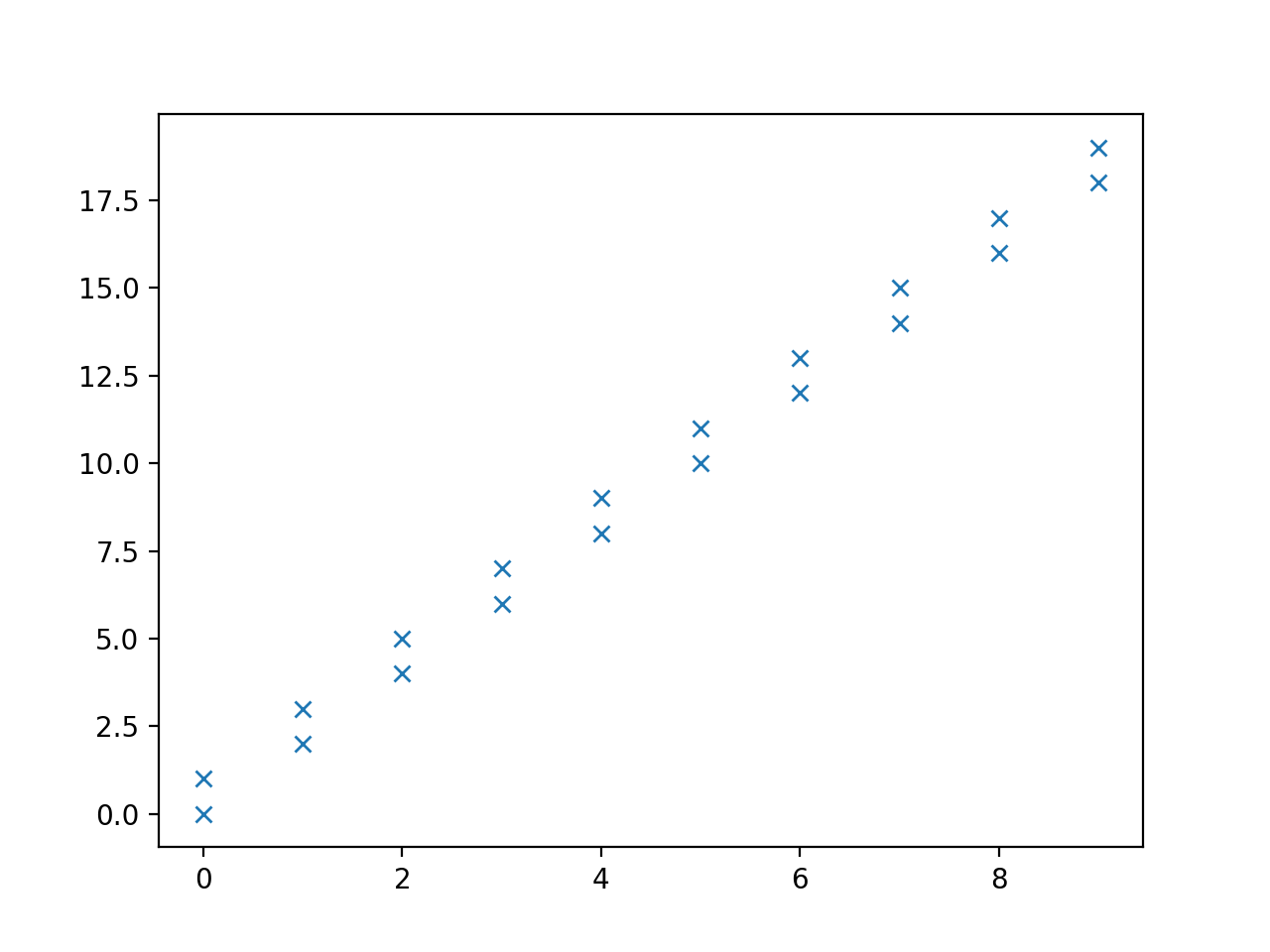
>>> P = np.linspace([0, 0], [1, 0], 10)
>>> Q = np.linspace([0, 1], [1, 1], 20)
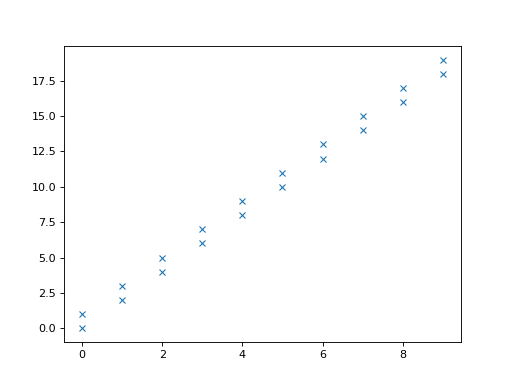
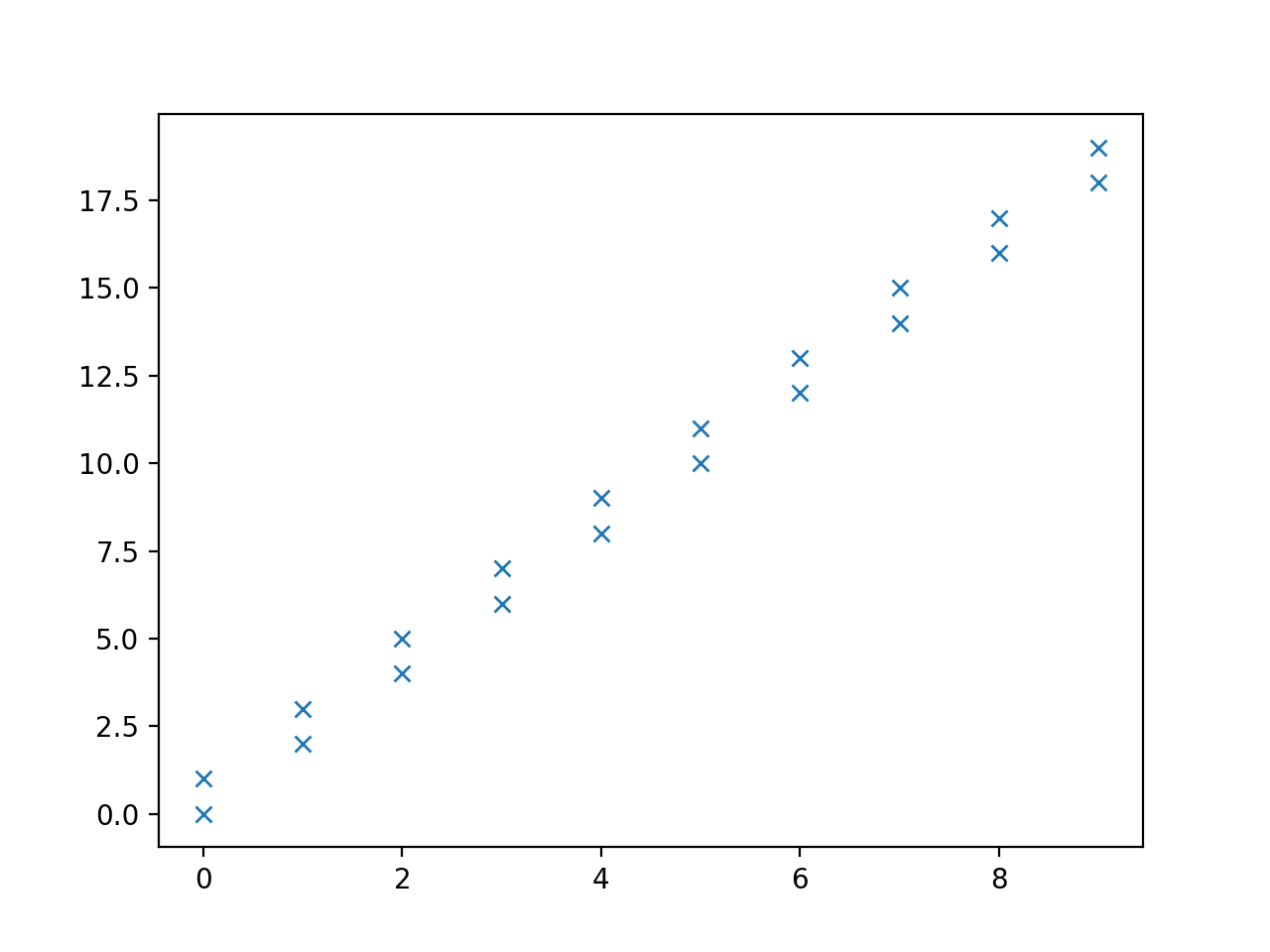
>>> dist, path = dtw_owp(P, Q)
>>> dist / len(path)  # averaged dynamic time warping
1.00...
>>> import matplotlib.pyplot as plt
>>> plt.plot(*path.T, "x")
(
Source code,png,hires.png,pdf)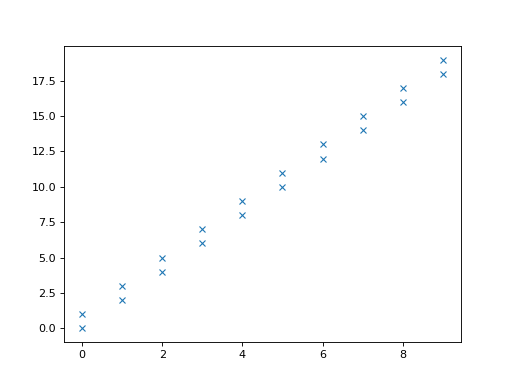
- curvesimilarities.dtw.sdtw(P, Q)[source]#
Squared dynamic time warping distance.
The squared dynamic time warping distance is defined as
\[\min_{C} \sum_{(i, j) \in C} \lVert P_i - Q_j \rVert^2,\]with symbols explained in
dtw().- Parameters:
- Parray_like
A \(p\) by \(n\) array of \(p\) vertices in an \(n\)-dimensional space.
- Qarray_like
A \(q\) by \(n\) array of \(q\) vertices in an \(n\)-dimensional space.
- Returns:
- distdouble
The squared dynamic time warping distance between P and Q, NaN if any vertice is empty.
- Raises:
- ValueError
If P and Q are not 2-dimensional arrays with same number of columns.
See also
Examples
>>> P = np.linspace([0, 0], [1, 0], 10)
>>> Q = np.linspace([0, 1], [1, 1], 20)
>>> sdtw(P, Q)
20.0...
- curvesimilarities.dtw.sdtw_owp(P, Q)[source]#
Squared dynamic time warping distance and its optimal warping path.
- Parameters:
- Parray_like
A \(p\) by \(n\) array of \(p\) vertices in an \(n\)-dimensional space.
- Qarray_like
A \(q\) by \(n\) array of \(q\) vertices in an \(n\)-dimensional space.
- Returns:
- distdouble
The squared dynamic time warping distance between P and Q, NaN if any vertice is empty.
- owpndarray
Indices of P and Q for optimal warping path, empty if any vertice is empty.
- Raises:
- ValueError
If P and Q are not 2-dimensional arrays with same number of columns.
Examples
>>> P = np.linspace([0, 0], [1, 0], 10)
>>> Q = np.linspace([0, 1], [1, 1], 20)
>>> dist, path = sdtw_owp(P, Q)
>>> (dist / len(path))**0.5  # quadratic mean dynamic time warping
1.00...
>>> import matplotlib.pyplot as plt
>>> plt.plot(*path.T, "x")
(
Source code,png,hires.png,pdf)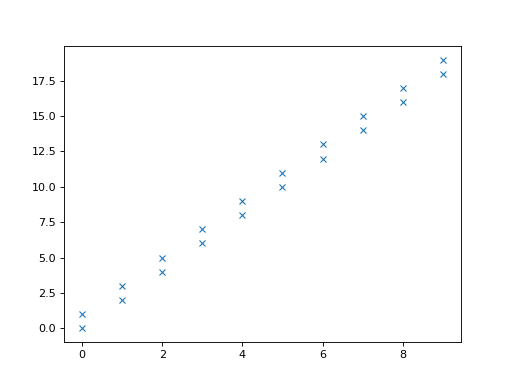
Integral Fréchet distance#
Integral Fréchet distance.
- curvesimilarities.integfrechet.ifd(P, Q, delta)[source]#
Integral Fréchet distance between two open polygonal curves.
Let \(f, g: [0, 1] \to \Omega\) be curves defined in a metric space \(\Omega\). Let \(\alpha, \beta: [0, 1] \to [0, 1]\) be continuous non-decreasing surjections, and define \(\pi: [0, 1] \to [0, 1] \times [0, 1]\) such that \(\pi(t) = \left(\alpha(t), \beta(t)\right)\). The integral Fréchet distance between \(f\) and \(g\) is defined as
\[\inf_{\pi} \int_0^1 \delta\left(\pi(t)\right) \cdot \lVert \pi'(t) \rVert \mathrm{d}t,\]where \(\delta\left(\pi(t)\right)\) is a distance between \(f\left(\alpha(t)\right)\) and \(g\left(\beta(t)\right)\) in \(\Omega\) and \(\lVert \cdot \rVert\) is a norm in \([0, 1] \times [0, 1]\). In this implementation, we use the Euclidean distance for \(\delta\) and the Manhattan norm for \(\lVert \cdot \rVert\).
- Parameters:
- Parray_like
A \(p\) by \(n\) array of \(p\) vertices in an \(n\)-dimensional space.
- Qarray_like
A \(q\) by \(n\) array of \(q\) vertices in an \(n\)-dimensional space.
- deltadouble
Maximum length of edges between Steiner points.
- Returns:
- distdouble
The integral Fréchet distance between P and Q, NaN if any vertice is empty or both vertices consist of a single point.
- Raises:
- ValueError
If P and Q are not 2-dimensional arrays with same number of columns.
See also
ifd_owpIntegral Fréchet distance with optimal warping path.
Notes
This function implements the algorithm of Brankovic et al [4].
References
Examples
>>> ifd([[0, 0], [0.5, 0], [1, 0]], [[0, 1], [1, 1]], 0.1)
2.0
- curvesimilarities.integfrechet.ifd_owp(P, Q, delta)[source]#
Integral Fréchet distance and its optimal warping path.
- Parameters:
- Parray_like
A \(p\) by \(n\) array of \(p\) vertices in an \(n\)-dimensional space.
- Qarray_like
A \(q\) by \(n\) array of \(q\) vertices in an \(n\)-dimensional space.
- deltadouble
Maximum length of edges between Steiner points.
- Returns:
- distdouble
The integral Fréchet distance between P and Q, NaN if any vertice is empty or both vertices consist of a single point.
- owpndarray
Optimal warping path, empty if any vertice is empty or both vertices consist of a single point.
- Raises:
- ValueError
If P and Q are not 2-dimensional arrays with same number of columns.
Examples
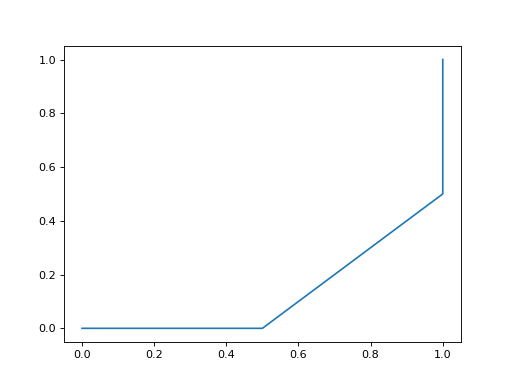
>>> dist, path = ifd_owp([[0, 0], [0.5, 0], [1, 0]], [[0.5, 1], [1.5, 1]], 0.1)
>>> import matplotlib.pyplot as plt
>>> plt.plot(*path.T)
(
Source code,png,hires.png,pdf)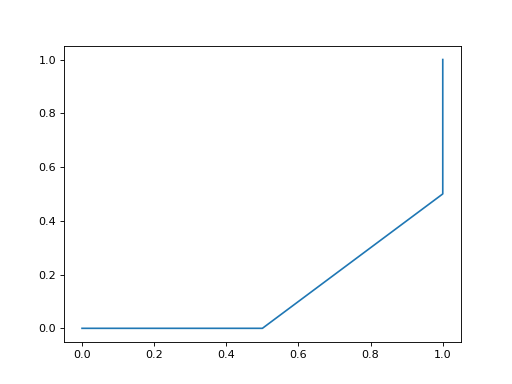
Average Fréchet distance#
Average Fréchet distance and its variants.
- curvesimilarities.averagefrechet.afd(P, Q, delta)[source]#
Average Fréchet distance between two open polygonal curves.
The average Fréchet distance is defined as [5]
\[\inf_{\pi} \frac{ \int_0^1 \delta\left(\pi(t)\right) \cdot \lVert \pi'(t) \rVert \mathrm{d}t }{ \int_0^1 \lVert \pi'(t) \rVert \mathrm{d}t },\]with symbols explained in
ifd(). We use the Manhattan norm for \(\lVert \cdot \rVert\), so the formula can be reduced to\[\frac{1}{\lvert f \rvert + \lvert g \rvert} \inf_{\pi} \int_0^1 \delta\left(\pi(t)\right) \cdot \lVert \pi'(t) \rVert \mathrm{d}t,\]where \(\lvert \cdot \rvert\) denotes the length of a polygonal curve.
- Parameters:
- Parray_like
A \(p\) by \(n\) array of \(p\) vertices in an \(n\)-dimensional space.
- Qarray_like
A \(q\) by \(n\) array of \(q\) vertices in an \(n\)-dimensional space.
- deltadouble
Maximum length of edges between Steiner points.
- Returns:
- distdouble
The average Fréchet distance between P and Q, NaN if any vertice is empty or both vertices consist of a single point.
- Raises:
- ValueError
If P and Q are not 2-dimensional arrays with same number of columns.
See also
ifdIntegral Fréchet distance.
afd_owpAverage Fréchet distance with optimal warping path.
Notes
Using this function is marginally faster than calling
ifd()and then dividing.References
Examples
>>> afd([[0, 0], [0.5, 0], [1, 0]], [[0, 1], [1, 1]], 0.1)
1.0
- curvesimilarities.averagefrechet.afd_owp(P, Q, delta)[source]#
Average Fréchet distance and its optimal warping path.
- Parameters:
- Parray_like
A \(p\) by \(n\) array of \(p\) vertices in an \(n\)-dimensional space.
- Qarray_like
A \(q\) by \(n\) array of \(q\) vertices in an \(n\)-dimensional space.
- deltadouble
Maximum length of edges between Steiner points.
- Returns:
- distdouble
The average Fréchet distance between P and Q, NaN if any vertice is empty or both vertices consist of a single point.
- owpndarray
Optimal warping path, empty if any vertice is empty or both vertices consist of a single point.
- Raises:
- ValueError
If P and Q are not 2-dimensional arrays with same number of columns.
Examples
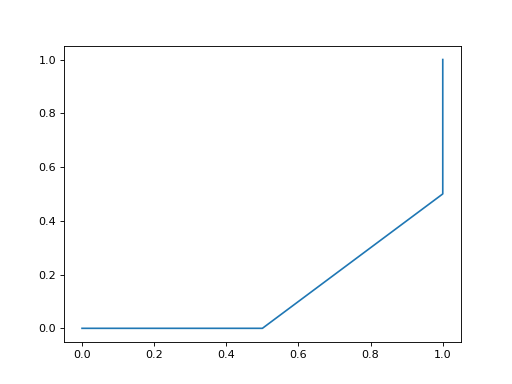
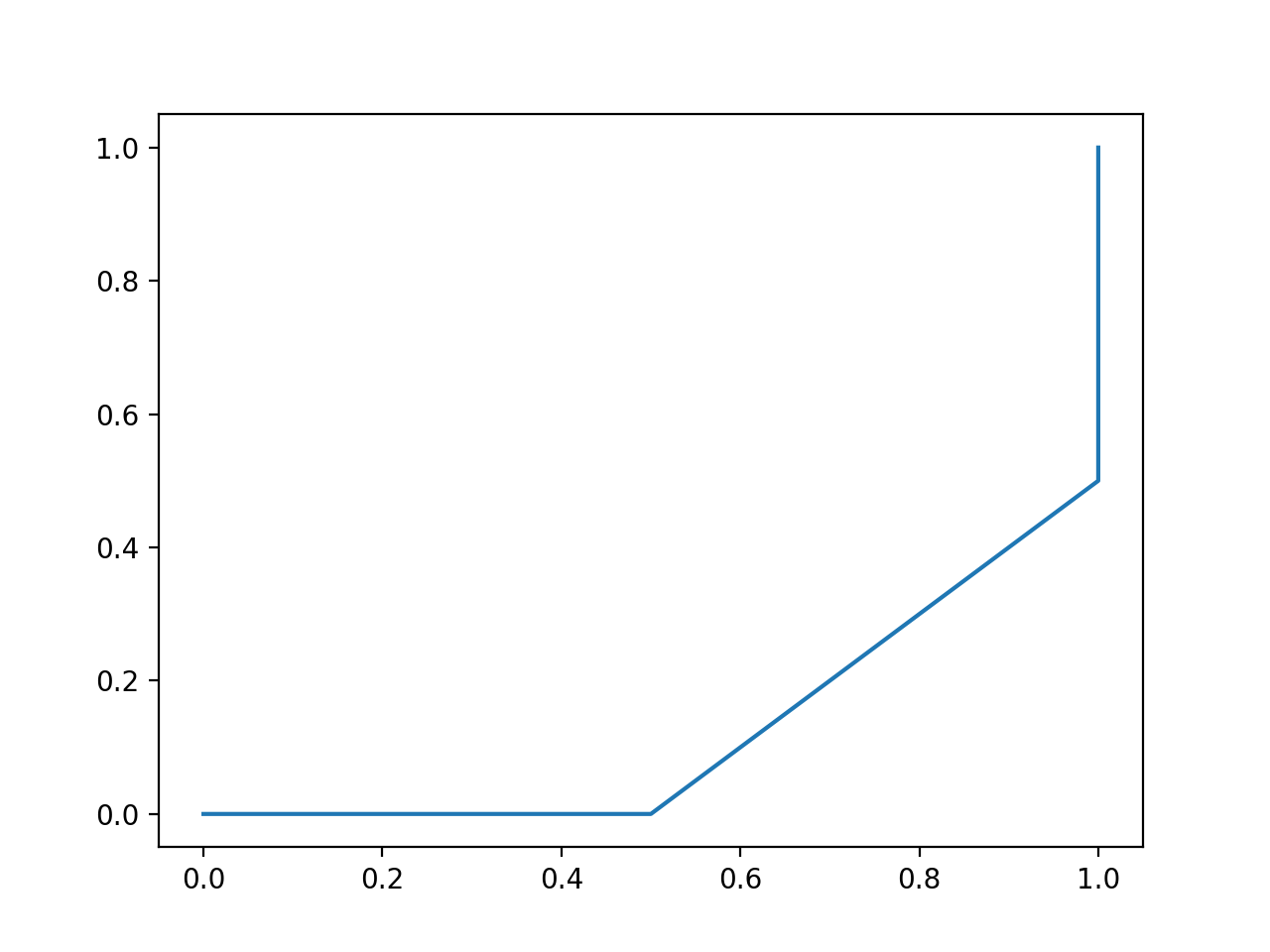
>>> dist, path = afd_owp([[0, 0], [0.5, 0], [1, 0]], [[0.5, 1], [1.5, 1]], 0.1)
>>> import matplotlib.pyplot as plt
>>> plt.plot(*path.T)
(
Source code,png,hires.png,pdf)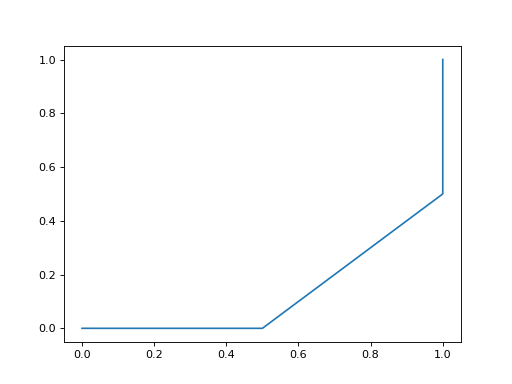
- curvesimilarities.averagefrechet.qafd(P, Q, delta)[source]#
Quadratic average Fréchet distance between two open polygonal curves.
The quadratic average Fréchet distance is defined as
\[\inf_{\pi} \sqrt{ \frac{ \int_0^1 \delta\left(\pi(t)\right)^2 \cdot \lVert \pi'(t) \rVert \mathrm{d}t }{ \int_0^1 \lVert \pi'(t) \rVert \mathrm{d}t } },\]with symbols explained in
ifd(). We use the Manhattan norm for \(\lVert \cdot \rVert\), so the formula can be reduced to\[\frac{1}{\sqrt{\lvert f \rvert + \lvert g \rvert}} \inf_{\pi} \sqrt{ \int_0^1 \delta\left(\pi(t)\right)^2 \cdot \lVert \pi'(t) \rVert \mathrm{d}t },\]where \(\lvert \cdot \rvert\) denotes the length of a polygonal curve.
- Parameters:
- Parray_like
A \(p\) by \(n\) array of \(p\) vertices in an \(n\)-dimensional space.
- Qarray_like
A \(q\) by \(n\) array of \(q\) vertices in an \(n\)-dimensional space.
- deltadouble
Maximum length of edges between Steiner points.
- Returns:
- distdouble
The quadratic average Fréchet distance between P and Q, NaN if any vertice is empty or both vertices consist of a single point.
- Raises:
- ValueError
If P and Q are not 2-dimensional arrays with same number of columns.
See also
Examples
>>> qafd([[0, 0], [0.5, 0], [1, 0]], [[0, 1], [1, 1]], 0.1)
1.0
- curvesimilarities.averagefrechet.qafd_owp(P, Q, delta)[source]#
Quadratic average Fréchet distance and its optimal warping path.
- Parameters:
- Parray_like
A \(p\) by \(n\) array of \(p\) vertices in an \(n\)-dimensional space.
- Qarray_like
A \(q\) by \(n\) array of \(q\) vertices in an \(n\)-dimensional space.
- deltadouble
Maximum length of edges between Steiner points.
- Returns:
- distdouble
The quadratic average Fréchet distance between P and Q, NaN if any vertice is empty or both vertices consist of a single point.
- owpndarray
Optimal warping path, empty if any vertice is empty or both vertices consist of a single point.
- Raises:
- ValueError
If P and Q are not 2-dimensional arrays with same number of columns.
Examples
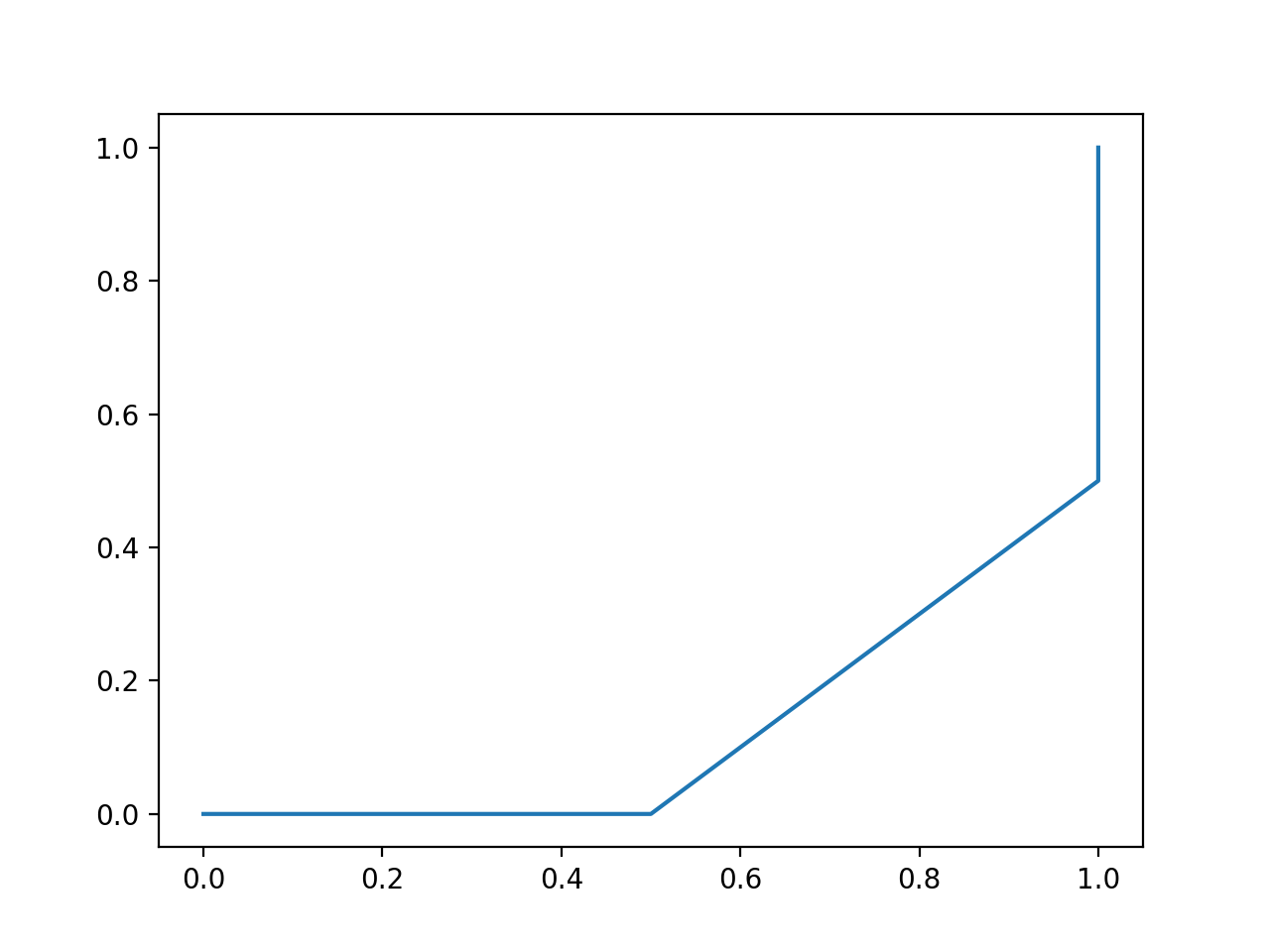
>>> dist, path = qafd_owp([[0, 0], [0.5, 0], [1, 0]], [[0.5, 1], [1.5, 1]], 0.1)
>>> import matplotlib.pyplot as plt
>>> plt.plot(*path.T)
(
Source code,png,hires.png,pdf)